
Why You Should Support Facilitating Regime Change in Iran
Some adversaries can and should "vanish from the page of time"

The Islamic Republic of Iran is a terrible blight on humanity. Since its inception in 1979—where Shia Islamists took advantage of a broad uprising against an unpopular and lightly autocratic Shah1 to seize power—the Islamic regime has consistently:
oppressed its people;
impoverished its people;
created and/or sponsored terrorist groups to threaten its neighbors and rivals; and
sought regional dominance and nuclear weapons2 with ideological fervor.3
Some observers of the situation oppose Western intervention and engineering regime change, judging it too hard or risky. Some even attempt to excuse the Islamic regime as actually quite rational4 and peaceful. After all, they’ve “never started a war” (a different question from overall malevolence). There is a strong sense of “Iraq Syndrome,” combined with common misunderstandings of Iran’s specific characteristics. Some like to focus on the idea that actually it’s America’s fault the Islamic Revolution against the Shah even happened, since we helped put the Shah back in place in 1953.5 (In my view, that would make Americans all the more morally responsible for putting the Islamic regime out of its misery.) While it’s true there are downside risks to Western intervention, one must also evaluate upside benefits. My contention is that the math here seems pretty straightforward at this point—geopolitically and morally.
This time it really is different
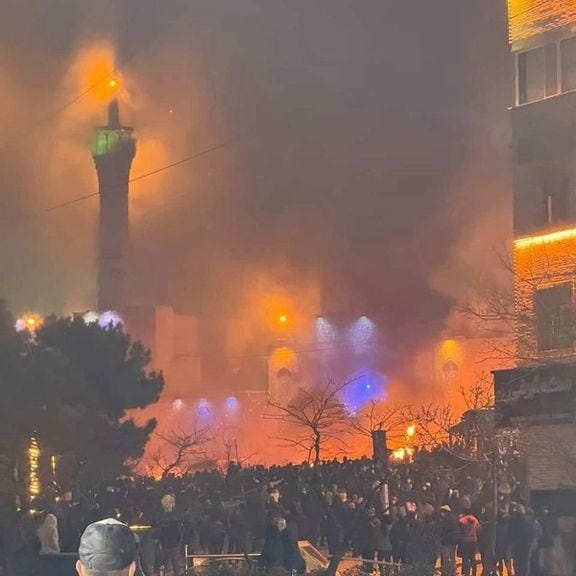
It was only with the occurrence of the 12-Day War in June 2025 that we came to understand how defenseless the Iranian regime is when confronted from the air by Satans Large and Small. Unfortunately, Iran’s domestic control on the ground is not so toothless. The prime leaders of the Iranian regime grew up as revolutionaries against the state, giving them a personal fear of and intimate knowledge how to counteract the risk of popular uprisings. They have decades of building institutional defenses against the public, with the ideologically aligned Islamic Revolutionary Guard Corps (IRGC) as the key component to ensure the regular military does not take over. The country’s telecommunications network was built to be turned off as needed, which is why as I write this there is an ongoing blackout of even local communications. Prior protests have given the various security forces a great deal of experience dealing with major unrest, especially in 2009 and 2022.
Still, the ultimate fate of the Islamic regime seems sealed now. They can’t keep ruling like this. Economic conditions are dire, with little hope of significant recovery. The regime can’t print money to get out of inflation and low productivity. The protestors know that the regime can’t defend itself against Israel, let alone the US. Everyone knows Iran has no significant allies to bail it out with funds or security assistance. Unlike the massive protests in 2009 and 2022, this time the stated goal is explicitly regime change. For its part, the regime is responding with a great deal of lethal force.
There is a decent chance these protests succeed all on their own. If these protests fail now, the fundamental predicament the regime faces will only worsen.6 The regime knows its back is against the wall. They have every incentive to fight the protests to save their own skins. The only resort they have is brutality. That’s why the West should give a helping hand by perhaps bombing some worthwhile targets of the state security apparatus. Maybe give the security forces a good reason not to show up for work.
What could go wrong
Whether the Islamic regime falls sooner or later—with or without external involvement—things could get messy. The situation could perhaps devolve into a protracted civil war if the regime is only partially defeated, Syria-style.7 Iran is a large country with a diverse population, so while it does have a long history of being a united entity, there are separatist factions—we can’t know what that would evolve into should the regime weaken and/or fall. It is critical to remember that this risk is baked in, irrespective of Western intervention. A speedy end to the regime could forestall some of the worst-case scenarios from protracted conflict.
The bottom line is that it’s hard to imagine a worse long-term situation for the Iranian people, or the world, than the Islamic regime continuing its incompetent and malevolent rule.
The reason you know the Shah was merely “lightly autocratic” is that he gave up the reins of power without much of a fight. The Islamic Regime proved they were far more brutal in very short order. And deeply incompetent at economics, derailing massive growth the under the Shah. Consider also how much pro-Shah rhetoric is coming from the present protestors.
I supported the JCPOA with the hope it would empower Iranian moderates and reformists over time, and I opposed the US withdrawing from it. But that time is past.
The leadership and managerial class of the Islamic regime truly does believe in their interpretation of Shia Islam and rule by cleric. They are not pretending; they do not merely believe in belief. It informs everything they do at home and abroad. They will continue to kill and die for those beliefs, at home and abroad.
There is a method to their madness. But it is still madness at its foundation.
It’s outside the scope of this essay, but the prevailing narrative against the Shah in favor of Mossadegh is wrong on some key points. Regardless, the mullahs didn’t like Mossadegh much either.
There will also presumably be a great many executions of arrested protestors.
I think that US military intervention is a good idea for the following, in a rough order of importance: Iran, Cuba, Haiti.
Iran for all the reasons you described. The question is what happens next, and I have a very hard time believing that it's worse than what we have now. A peaceful transition seems unlikely with how deeply intertwined the IRGC is with the regime and current situation, so any intervention needs to take into account that the IRGC needs to go with them (the current Venezuelan situation is ... disappointing).
Haiti *is* a failed state, so it would really be a good idea to revive old efforts at building a coalition military force to go restore order. It won't be easy, but we literally can't make it worse and an Afganistan situation is extremely unlikely. But the ROI of such an endeavour is deeply negative, so it's really more a humanitarian effort than anything else.
Cuba is a long and complicated story, but basically I think the US really does need to clean up its back yard. Unlike Haiti, the state is actually effective, so intervention is tricky in a different way. It'll be really hard -- my 5-minute sketch of an idea is cobbling together enough of the Cuban diaspora in the US to build a semi-legitimate government after a brief military occupation. But unlike Haiti I think the ROI on this is positive after admittedly not much thinking about it.